

Bloating, Brain Fog, and Your Microbiome: The Gut Health Guide for Women Over 40
Something shifted in your digestion and you can't quite pinpoint when. Maybe it started with bloating that lingers no matter what you eat. Or the creeping constipation. Or that unsettling feeling that foods you've enjoyed for decades are suddenly disagreeing with you.
You're not imagining it. A landmark study presented at The Menopause Society's 2025 meeting found that 94 percent of women aged 44 to 73 experience digestive symptoms—and 82 percent reported those symptoms either began or worsened during perimenopause and menopause. Bloating alone affected 77 percent of the women surveyed.
What most women don't hear from their doctors—and what I want you to understand—is that these changes aren't random. They're connected to the same hormonal shifts driving your hot flashes, your disrupted sleep, and your mood changes. Your gut and your hormones are in constant conversation, and right now, that conversation is getting loud.
The Estrobolome: Your Gut's Hidden Hormone Regulator
Let's start with a concept that's changing how we understand the menopause transition: the estrobolome. It's the collection of bacteria in your gut that produce an enzyme called beta-glucuronidase, which plays a critical role in how your body recycles estrogen.
Here's the short version: your liver processes estrogen into an inactive form and sends it to your gut for elimination. But estrobolome bacteria reactivate some of that estrogen, allowing it to be reabsorbed back into circulation. When this system works well, it acts as a secondary estrogen regulator—a backup system that helps maintain hormonal balance.
A 2022 study of 2,300 women published in mSystems revealed something striking: postmenopausal women had significantly less microbial diversity and decreased estrobolome activity compared to premenopausal women. Their gut microbiome had, in effect, become more similar to men's.
This creates a compounding problem. As ovarian estrogen production declines during perimenopause, you need your estrobolome working well to help recirculate what estrogen remains. But the decline in estrogen itself disrupts the gut bacteria responsible for that recycling. It's another one of those vicious circles the body falls into during this transition—the hormonal shifts weaken the very system designed to buffer them.
Why Your Gut Lining Is More Vulnerable Now
Estrogen isn't just a reproductive hormone. It's a gut protector. Estrogen receptors line your entire gastrointestinal tract, and estrogen helps maintain the tight junctions between your intestinal cells—the microscopic seals that decide what gets through and what stays out.
Data from the Study of Women's Health Across the Nation (SWAN) measured gut permeability markers in 65 women before and after menopause. The results were clear: FABP2, a marker of gut barrier dysfunction, increased by 22.8 percent. Markers of microbial translocation—meaning bacterial products leaking into the bloodstream—also rose significantly.
When your gut barrier weakens, fragments of bacteria and their byproducts enter your circulation and trigger a low-grade inflammatory response. This systemic inflammation doesn't announce itself with acute symptoms. Instead, it shows up as joint stiffness, brain fog, fatigue, and—over time—contributes to the cardiovascular and bone density changes that accelerate after menopause. The SWAN researchers found that greater gut permeability was directly associated with higher inflammation markers and lower bone mineral density at the lumbar spine and hip.
Your gut isn't just digesting food. It's either protecting you from inflammation or contributing to it. And during perimenopause, the balance tips.
The Gut-Brain Connection You're Feeling
If brain fog, anxiety, or mood changes have been part of your perimenopause experience, your gut is part of that story too.
Here's a fact that surprises most people: approximately 90 to 95 percent of your body's serotonin is produced in your gastrointestinal tract. Not your brain—your gut. The microbiota play a direct role in supporting this production. In animal studies, mice without gut bacteria produced roughly 60 percent less serotonin than those with normal microbial populations.
During perimenopause, serotonin takes a triple hit. Estrogen directly promotes serotonin synthesis by activating the enzyme that makes it. Estrogen also increases the availability of serotonin receptors. And declining estrogen disrupts the gut microbiome that supports gut-based serotonin production. Three pathways, all compromised simultaneously.
The vagus nerve—the longest cranial nerve in your body—serves as the primary communication highway between your gut and brain. When gut dysbiosis impairs vagal signaling, the downstream effects include difficulty concentrating, heightened anxiety, disrupted sleep, and that pervasive sense that your emotional regulation has gone offline. It's not weakness. It's physiology.
What's Actually Happening With Bloating, Constipation, and Reflux
Let's address the symptoms that may have brought you here. That Menopause Society study broke down the numbers:
- Bloating: 77%
- Constipation: 54%
- Stomach pain: 50%
- Acid reflux: 49%
Over half the women surveyed experienced symptoms daily or weekly, and 55 percent reported significant impact on their quality of life. Yet only a third had received any formal diagnosis, and of those who sought professional help, 58 percent found it inadequate.
These symptoms aren't separate from your hormonal transition—they're part of it. Estrogen receptors throughout your GI tract influence motility, the speed at which food moves through your system. Fluctuating hormones affect nitric oxide production, which can relax the lower esophageal sphincter and contribute to reflux. Changes in your microbiome alter how you ferment fiber and produce gas. And elevated cortisol from chronic stress further slows digestion, reduces beneficial bacteria, and increases intestinal permeability.
If your digestion has changed, the explanation isn't "getting older." It's hormonal biology, microbiome ecology, and nervous system regulation all shifting at once.
Food as Medicine: What the Research Supports
Fermented Foods First
If I could change one dietary habit for every woman in perimenopause, this might be it. A Stanford study published in Cell randomized 36 healthy adults to either a high-fermented-food or high-fiber diet for 10 weeks. The fermented food group steadily increased microbial diversity, and 19 inflammatory proteins decreased—including interleukin-6, a marker linked to chronic inflammation, cardiovascular disease, and type 2 diabetes.
The researchers called it "one of the first examples of how a simple change in diet can reproducibly remodel the microbiota across a cohort of healthy adults."
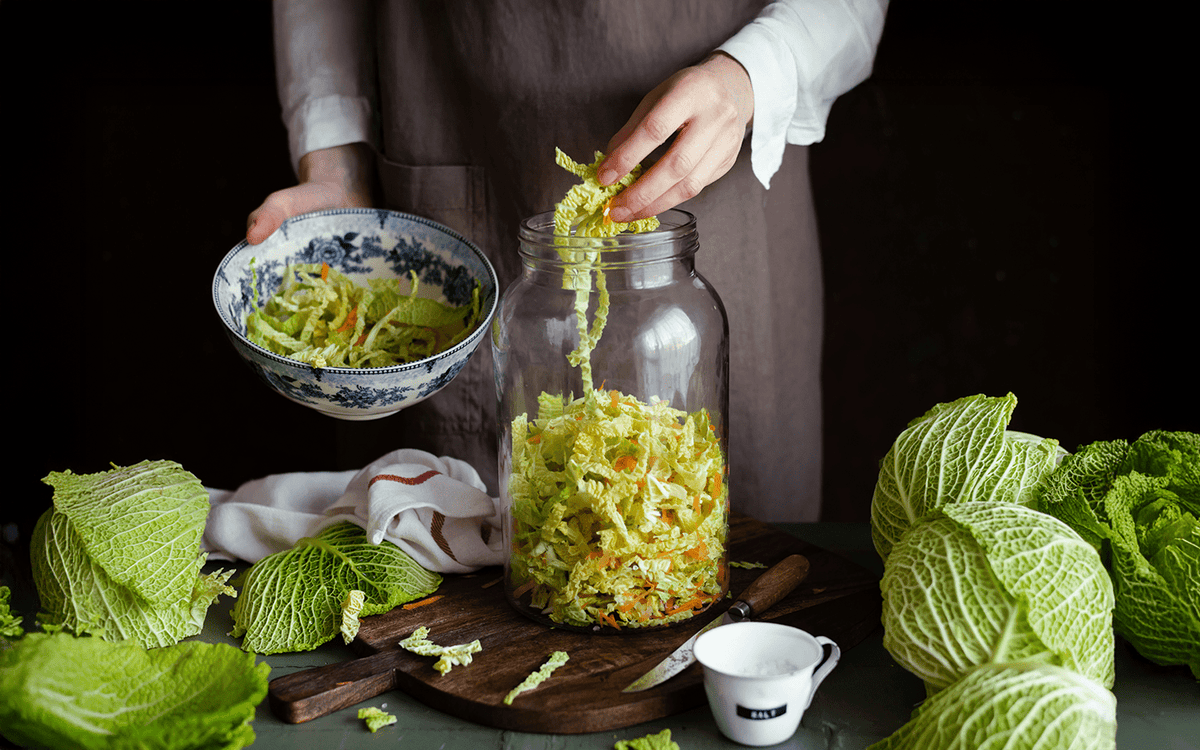
What counts: yogurt with live cultures, kefir, kimchi, sauerkraut, miso, kombucha. Aim for two to three servings daily. Start small if fermented foods are new to your diet—your microbiome needs time to adjust.
Fiber: The Foundation You're Probably Missing
Fiber matters enormously during menopause—and most women aren't getting nearly enough. Only 9 percent of American women meet the recommended 25 grams daily. The average intake hovers around 10 to 15 grams.
Fiber feeds your beneficial gut bacteria, which produce short-chain fatty acids (SCFAs)—particularly butyrate—that maintain gut barrier integrity, reduce inflammation, and support calcium absorption. When fiber intake is low, SCFA production drops, and the gut barrier weakens at precisely the moment it's already compromised by declining estrogen.
Practical targets: - Prebiotic-rich foods: garlic, onions, asparagus, bananas, Jerusalem artichoke, flaxseeds - Diverse fiber sources: legumes, whole grains, vegetables, fruits, nuts, seeds - Increase gradually to avoid the bloating that comes from a sudden fiber surge—your microbiome needs time to build the bacterial populations that process it efficiently
The Mediterranean Pattern
A Mediterranean-style diet consistently shows benefits for the gut microbiome: increased abundance of anti-inflammatory species like Faecalibacterium prausnitzii and Bifidobacterium, greater SCFA production, and reduced inflammatory markers. It also happens to be the dietary pattern most strongly associated with cardiovascular protection after menopause.
The core elements—olive oil, vegetables, legumes, whole grains, fish, nuts, fermented dairy—align beautifully with what your gut needs right now. And if you're wondering what you should actually be eating in midlife, this is the framework I return to most often.
What About Probiotics?
Probiotics are having a moment, and for menopausal women, some of the evidence is genuinely compelling—particularly for bone health.
A randomized trial published in The Lancet Rheumatology gave early postmenopausal women a combination of three Lactobacillus strains for 12 months. The result: virtually no bone loss in the probiotic group (negative 0.01 percent) compared to significant loss in the placebo group (negative 0.72 percent). A separate trial using Lactobacillus reuteri in older women showed a roughly 50 percent reduction in bone loss.
These findings make sense when you understand the gut-bone connection. Your microbiome directly influences calcium and mineral absorption, vitamin K production, and the level of systemic inflammation that drives bone resorption. When the microbiome is disrupted, bone health suffers downstream.
That said, not all probiotics are created equal. Strain specificity matters—the strains studied for bone health are different from those studied for vaginal health or mood. A broad-spectrum, multi-strain probiotic with documented Lactobacillus and Bifidobacterium species is a reasonable starting point, but this is an area where the science is still catching up to the marketing. More on this in a future deep dive.
A Chinese Medicine Perspective on Midlife Digestion
In my practice, I see digestive complaints through a lens that bridges what I've described above with something far older. In Chinese medicine, the digestive system is governed by the Spleen and Stomach—and the Spleen is considered the root of all post-natal energy. Everything you are, everything your body builds and repairs after birth, depends on the Spleen's ability to transform food into Qi and Blood.
Women are inherently more susceptible to Spleen Qi depletion because of the monthly demand of menstruation—decades of blood loss that require the Spleen to work harder to replenish. By the time perimenopause arrives, many women have been quietly running a deficit.
What makes this especially relevant in menopause is the Spleen-Kidney relationship. In Chinese medicine, Spleen Qi is rooted in Kidney Yang—the warming, activating energy that also declines naturally with age. When Kidney essence weakens during menopause, it can no longer adequately support the Spleen. The result: bloating, fatigue after eating, loose stools, food sensitivities, and a general sense that your digestion has lost its fire.
Modern research is catching up to this pattern in fascinating ways. Studies have found that animal models of Spleen deficiency show the same bacterial depletions—reduced Lactobacillus and Bifidobacterium—documented in postmenopausal women. The TCM pattern and the microbiome data are describing the same phenomenon through different languages.
In treatment, I work to strengthen Spleen Qi and warm Kidney Yang while addressing any Liver Qi stagnation that stress has created. Acupuncture at points like ST36 (Zusanli) has been shown to modulate vagus nerve activity and improve beneficial bacterial populations—essentially supporting the gut-brain axis through a mechanism we can now measure, even if we've been using it for centuries.
Where to Start
If your digestion has shifted during perimenopause, here's what I'd prioritize:
Feed your microbiome deliberately. Add fermented foods daily and increase fiber gradually toward 25 grams. These two changes alone can measurably shift microbial diversity and reduce inflammation.
Address the stress piece. Your nervous system and your gut are in constant dialogue. Chronic stress suppresses digestive function, depletes beneficial bacteria, and increases gut permeability. Whatever calms your nervous system—breathwork, acupuncture, walking, genuine rest—is also a digestive intervention.
Don't dismiss your symptoms. If 82 percent of women report digestive changes during this transition, this isn't a fringe complaint. It's a core feature of the hormonal shift, and it deserves the same attention as hot flashes and sleep disruption.
Consider working with a practitioner who understands the gut-hormone connection. Standard gastroenterology often evaluates the gut in isolation. The women I see in my practice get better when we address the whole pattern—hormones, nervous system, microbiome, and digestive function together.
The Bigger Picture
Your gut is not separate from the rest of what's happening in midlife. It's the intersection. Hormonal balance, bone density, cardiovascular health, mood, weight, immune function, and inflammation all run through your microbiome.
The encouraging news is that unlike your ovaries, your gut microbiome is responsive to intervention. It shifts within days to weeks of dietary changes. It responds to stress reduction, to fermented foods, to the right probiotic strains, and to the ancient practice of strengthening the Spleen and supporting the Kidney that we've used in Chinese medicine for millennia.
The digestive discomfort you're experiencing isn't something to power through or dismiss as "just getting older." It's your body asking for a different kind of attention. And when you give it that attention—when you nourish the ecosystem that regulates so much of your health—the benefits extend far beyond a flatter belly.
If you're ready to understand what's happening in your gut and build a plan that addresses the root pattern, I'm here for that conversation.