A Cooler Kind of Summer Eating: The Quiet Genius of Vegetables

It's Fourth of July weekend, the mercury is climbing, and I suspect you're doing what the rest of us are doing: trying, valiantly, not to combust.
There's a certain irony to it. We spend February fantasizing about heat, and then it arrives in earnest and we're wilting on the porch, fanning ourselves, wondering why the potato salad suddenly feels like a personal attack. So allow me to offer a small, unglamorous, wildly effective piece of advice for the weeks ahead—one that will not sell a best-selling book or a shiny online course, because nobody has ever gotten rich telling women to eat their vegetables.
I know. I can hear it already. It sounds exactly like a mother wagging her finger in that nasally voice, eat your vegetables, while you stare down a plate of undesirable, gray-green things. Stay with me anyway. Because grown, in the height of summer, from a local farm, with good olive oil, a squeeze of lemon and a sprinkle of Maldon salt, the vegetable is the most elegant cooling strategy we have.
The Advice Nobody Can Monetize
In recent years there's been an enormous amount of hullabaloo about women getting enough protein and enough fiber. And yes—I agree with all of it. Protein matters more than ever in midlife, and fiber is doing more for your hormones and your gut than most supplements on the shelf.
But notice something: no one is talking about women getting enough vegetables. Partly, I think, because you simply cannot build an empire on the phrase. It's too plain. It doesn't come with a proprietary blend or a founder's origin story. It just… works, has always worked, and asks nothing of you but a trip to the farm stand.
As a woman with two decades of clinical practice behind me, I can tell you vegetables are one of the few interventions I recommend that has no downside at all. I picked mine up yesterday from a local farm, and dressed them simply: sea salt, olive oil, fresh lemon. That's it. Almost any vegetable, treated with a little respect, becomes delicious. The peppery arugula, the sweet snap of a just-picked green bean, a tomato that actually tastes like a tomato.
And while you're enjoying them, something quietly remarkable is happening on a cellular level.
Younger Than Your Biological Age
Let me explain the part that excites me, because it reframes the whole "eat your vegetables" conversation from obligation to investment.
Your chronological age is simply how long you've been breathing air in and out on this planet. But the biological age of your cells, how old you really are on the inside, is a different story. Much of it comes down to your telomeres, the protective caps on the ends of your chromosomes that shorten as cells divide and age. The good news: telomere length can be measured, and it gives us a far more honest picture of aging than a birthday ever could.
And vegetables, it turns out, protect them.
In a study of more than 5,400 U.S. adults, researchers found that telomeres were meaningfully longer in people who ate more fruits and vegetables: roughly 1.9 fewer years of biological aging for every extra 100 grams consumed. Comparing the highest vegetable eaters to the lowest, the gap stretched to about 4.4 years of cellular aging. Four years. From something you can buy at a roadside stand for the price of an iced coffee.
Here's the detail I love, and the one I flag for every woman who sits across from me: in that research, both fruits and vegetables predicted longer telomeres in women, while in men, only vegetables did. Our bodies, it seems, are especially responsive to what grows in the ground. When a patient tells me she's overwhelmed by all the conflicting advice, keto, paleo, carnivore, fasting, I tell her to start here, because this is the one recommendation the evidence never seems to walk back.
The mechanism isn't fully mapped, but it points where you'd expect: vegetables are dense with phytonutrients, the polyphenols, flavonoids, and pigments that give plants their color, and these compounds are anti-inflammatory and antioxidant. They calm the low-grade inflammation and oxidative stress that fray our telomeres in the first place.
That same quieting of inflammation is likely why higher vegetable intake keeps turning up alongside lower cancer risk, study after study. One large dose-response analysis found that eating roughly 550 to 600 grams of produce a day was associated with about a 14% lower risk of cancer overall. The cruciferous family (broccoli, cabbage, kale, Brussels sprouts) looks especially busy here: an umbrella review of 22 meta-analyses tied it to reduced risk across several cancers, and for my patients in midlife, one finding stands out. Higher cruciferous intake is associated specifically with lower postmenopausal breast cancer risk. Let me be honest about what that means: these are associations, not cures, and no vegetable treats cancer. But it's an awfully consistent pattern for something you can toss with olive oil and lemon.
This matters enormously in midlife, when declining estrogen removes some of the natural anti-inflammatory buffer we enjoyed in our younger years. Vegetables help fill that gap. In one trial of postmenopausal women specifically, a diet rich in polyphenol foods improved blood pressure, cholesterol, and inflammatory markers, the exact risks that rise for us after menopause.
So no, "eat your vegetables" doesn't fit on a supplement label. It just makes you measurably younger from the inside out.
Now, Back to the Heat
Here's where Chinese medicine adds a layer that modern nutrition largely ignores. In my tradition, every food carries its own energetic quality—not just its calories or its macros, but its thermal nature. Some foods stoke the fire inside us. Others cool it. And in the middle of a heat wave, that distinction is everything.
The nature of most non-starchy vegetables is naturally cooling. (Let's set aside potatoes and sweet potatoes for the moment, since they're warming and starchy, but keep beets on the table; they're wonderful.) Cucumber, leafy greens, zucchini, celery, tomatoes, summer squash: these are the foods that help your body shed heat rather than store it. It's no accident that they happen to be exactly what's ripe and abundant right now. Nature tends to grow the medicine we need in the season we need it.
But here's the nuance that surprises most people: cooling does not mean cold. In Chinese medicine, ice-cold food and drink actually disrupt digestion. Your body has to spend precious energy warming that iced smoothie back to internal temperature before it can do anything useful with it, which, ironically, generates heat. The sweet spot is room temperature.
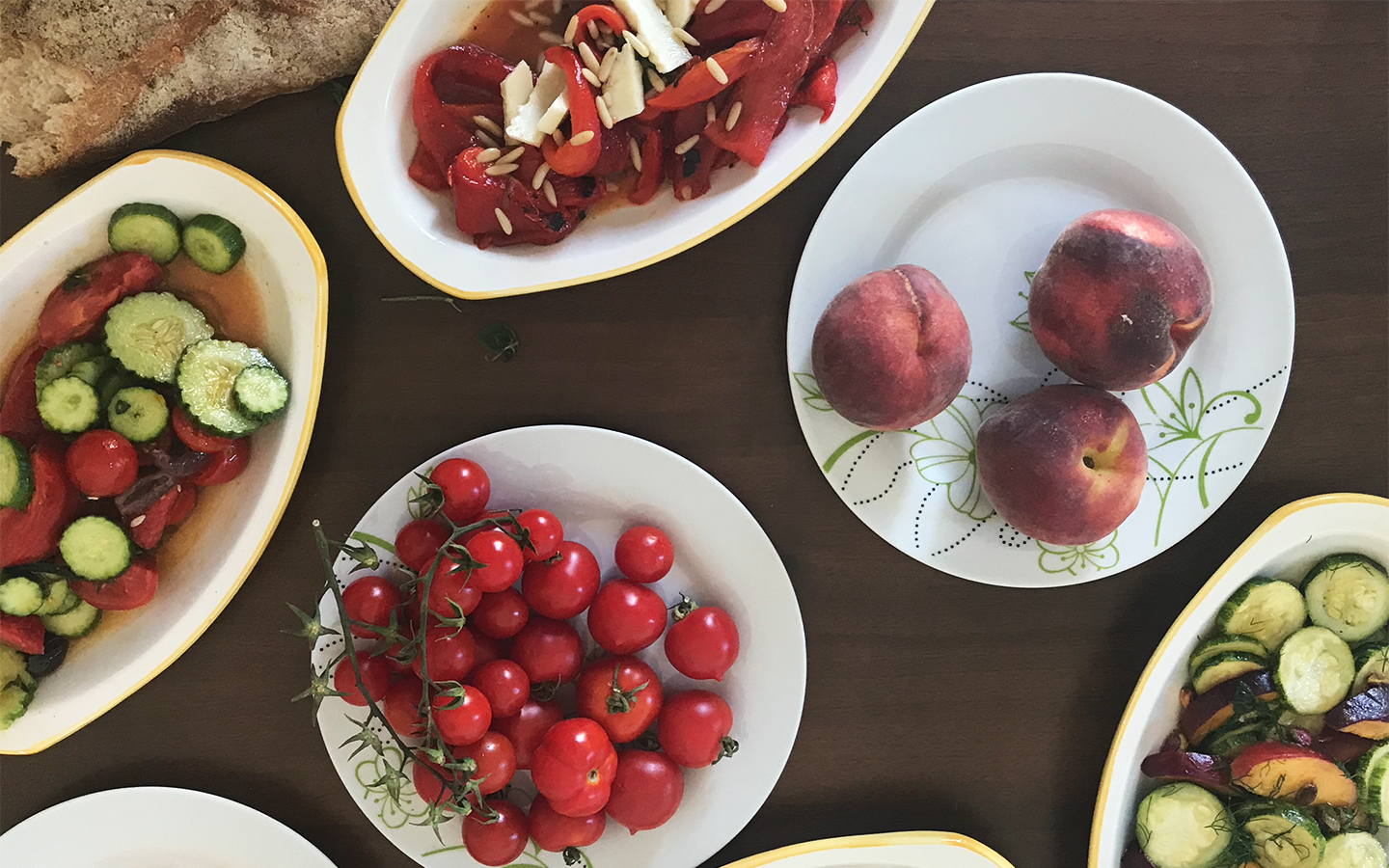
Think of a midday feast in Sicily in the height of summer: tables of gorgeous, fresh food, all served at room temperature. Nothing scalding hot, nothing shocking cold. Just abundance, in balance with the weather outside. That instinct, refined over centuries in a hot climate and entirely without a single peer-reviewed study, is precisely what Chinese medicine would prescribe. The old cultures figured out cooling long before we had a word for thermoregulation.
If you want the full ritual toolkit for a heat wave, from hydration to skin to calming a jumpy midlife thermostat, I've laid it all out in my Heat-Wave Survival Guide. Consider this its companion at the dinner table.
What Cooling Actually Looks Like on a Plate
You don't need a recipe so much as a principle: fresh, seasonal, plant-forward, and gently dressed. A few ways I actually eat in July:
- A big room-temperature vegetable plate. Whatever the farm had, shaved, torn, or left whole, with olive oil, lemon, and flaky salt. That's the whole recipe.
- Cucumber, mint, and a little sea salt. About as cooling as food gets, and it takes ninety seconds.
- Leafy greens and beets, room temperature, not straight from the fridge.
- A pause before the ice. Let your sparkling water sit a few minutes. Your digestion will thank you more than your first sip suggests.
And if you want to go deeper on eating for your hormones through the transitions of midlife, that's a fuller conversation I've had over what to eat in midlife for hormone balance and eating to support gut health through menopause. A cooling summer plate and a hormone-friendly one turn out to be close cousins.
The Other Side of the Ledger
I'd be a poor guide if I only told you what to eat and not what turns up the heat, so, at the risk of being a bit of a Debbie Downer on a holiday weekend, here it is.
Spicy food and alcohol both heat the system. That's the energetic reality, however delicious the margarita. If you're already struggling with hot flashes or that internal furnace so many women describe in perimenopause, a spicy, boozy afternoon in the sun is pouring gasoline on a fire you're trying to put out. (Beer, oddly, tends to run a touch less heating than spirits. Make of that what you will.)
And then there's the sun itself. I adore a little vitamin D as much as anyone; it's genuinely good for mood, for bones, for immunity. But there's a meaningful difference between a little sunshine and baking yourself to a crisp. Getting thoroughly sunburned in the midday heat doesn't help the overall situation one bit.
This isn't deprivation, it's discernment: knowing which pleasures cool you and which ones cost you, and choosing with a bit more intention when the thermometer is against you.
The Whole Point
Somewhere between the finger-wagging of childhood and the wellness-industrial complex of adulthood, we lost the plot on the simplest advice there is. Vegetables won't trend. They won't come with a founder's story or a subscription. They'll just make you cooler, calmer, and a little younger, one room-temperature, lemon-dressed, farm-fresh plate at a time.
So this weekend, in between the fireworks and the fun, do the deeply unfashionable thing. Eat your vegetables. Not because your mother said so, but because, twenty years into caring for women's bodies, I've never once seen it fail.
If the heat is doing more than making you sweat, if it's wrecking your sleep, spiking your anxiety, or turning your hot flashes up to eleven, that's worth addressing at the root. Acupuncture and Chinese medicine are wonderfully good at helping the body find its own thermostat again. Come see me, and let's get you through the summer with a little more ease.