

Facial Acupressure Points: The Complete Guide to a Lifted, Glowing Face
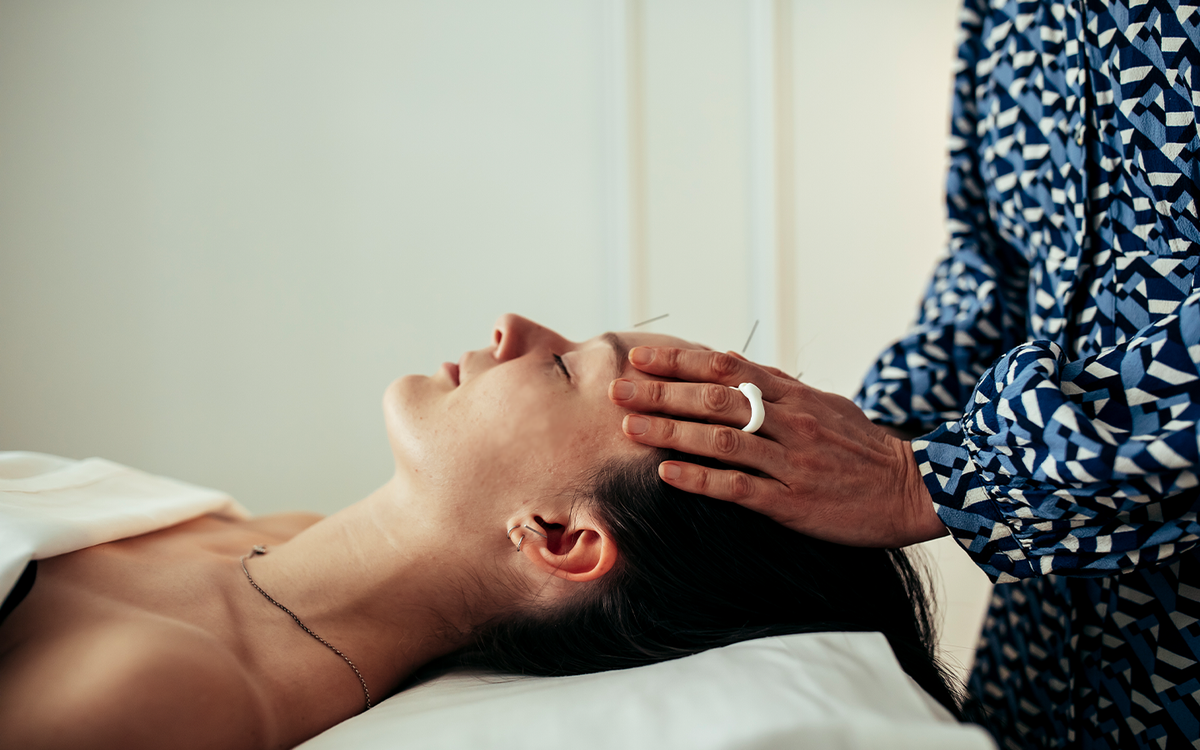
There's a version of self-care that costs nothing, lives entirely in your own two hands, and takes about as long as brushing your teeth. I do it most mornings, usually before I've said a word to anyone. A few minutes of pressing the right points on my face, and the skin that looked a little tired in the mirror looks awake again, with that soft flush you'd get from a brisk walk.
That's facial acupressure. Not a gadget, not a serum, not another thing to buy. It's one of the oldest tools in Chinese medicine, scaled down to something you can do in bed before your feet hit the floor. For women moving through midlife, when skin gets drier and the face holds more tension than it used to, it's become one of the small rituals I recommend most. Here's how it works, where the points are, and an honest account of what it can and can't do.
What facial acupressure actually is
Acupressure is acupuncture without the needles. You use your fingertips to hold steady pressure on specific points along the body's channels, the same points an acupuncturist would needle. Facial acupressure simply brings that practice to the face.
It isn't random face-rubbing. The difference is that you're working defined points, each one sitting over a place where circulation pools, a muscle tends to grip, or a nerve runs close to the surface. Press the right spots, breathe, and you're nudging blood flow and releasing tension in the places that shape how rested your face looks.
In Chinese medicine, these points sit along meridians, and we talk about moving qi and freeing what's stuck. You don't have to adopt that framework to benefit. The same points map neatly onto things modern research can measure: blood flow, muscle tension, and the nervous system.
How it works (and what the research actually shows)
Three mechanisms do most of the work, and they're better studied than you might expect.
Circulation. Manual stimulation brings blood to the surface. In one study, a five-minute facial massage raised blood flow in the cheek by roughly 25% for at least ten minutes afterward, and five weeks of regular massage improved the blood vessels' ability to dilate on their own (Hayashi et al., Complementary Therapies in Medicine, 2018). More blood means more oxygen and nutrients reaching the skin. That's the flush, and it's why your face looks brighter right after.
Muscle and fascia. Years of squinting, frowning, and clenching shorten the small facial muscles, and the fascia wrapping them tightens too. Working those muscles has measurable effects: in a 20-week trial published in JAMA Dermatology, a daily facial-exercise routine made women aged 40 to 65 look about three years younger to blinded raters. Acupressure is gentler than exercise, since you're holding and releasing rather than contracting, so think of it as easing tension rather than building muscle. But it works on the same tissue.
The nervous system. This is the one women tell me they feel first. Acupressure has a solid evidence base for calming the body: a 2022 meta-analysis of 27 studies found it significantly reduced anxiety (Chen et al., Journal of Integrative and Complementary Medicine). When your shoulders drop and your jaw unclenches, your face softens with them. Stimulating acupoints is a recognized therapeutic approach with real evidence behind it for several conditions (NCCIH).
A fair word on the evidence: most of this research is on facial massage, facial exercise, and body acupressure rather than facial acupressure specifically, which is understudied. What we can say honestly is that the mechanisms it works through are real and measurable. The traditional framework is older than any of these studies and worth respecting on its own terms.
What it can do for you, and what it can't
Let's be clear-eyed, because the internet is not.
Facial acupressure can give you a brighter, more awake complexion from better circulation. It can soften the look of fine lines by releasing the tension that deepens them (the wrinkle-specific points have their own guide). It can reduce morning puffiness by encouraging fluid to move (more on de-puffing here). It can ease the jaw and brow tension that pulls the lower face down. And it can calm your whole system, which shows on your face whether you mean it to or not.
What it can't do is erase a deep, set wrinkle, replace volume that's been lost, or stand in for Botox or filler. Anyone promising a needle-free facelift from finger pressure is selling something. The honest frame is pro-aging: you're working with your face to keep it healthy and rested, not fighting a war against it. The results are real, gradual, and best measured in how your skin looks over weeks, not minutes.
The main points, by region
You don't need to memorize Chinese names or treat this like an anatomy exam. Find the spot, press, breathe. Here's a full-face map; each point has its traditional name in parentheses.
| Point (traditional name) | Where it is | What it's for |
|---|---|---|
| Between the brows (Yintang) | Where frown lines and the "11s" form | Calming — a good place to start |
| Inner brow corners (Cuanzhu, BL-2) | Inner corner of each brow | Heaviness and tension around the eyes |
| Mid-brow (Yuyao) | Midpoint of each brow | Wakes up circulation across the forehead |
| Temples (Taiyang) | The hollow at each temple | Crow's feet and side-of-face tension headaches |
| Under-eye (Sibai, ST-2) | Below the pupil, on the cheekbone | Under-eye area, puffiness, brightening |
| Beside the nostril (Yingxiang, LI-20) | Along the nasolabial fold | The laugh-line area; also sinus congestion |
| Jaw (Jiache, ST-6) | The jaw muscle that bulges when you clench | Releases clench-tension; softens the lower face |
For the wrinkle-specific routine, my facial acupressure for fine lines guide goes deeper. This pillar is the map; that post is the close-up.
A simple daily routine
Five to eight minutes is plenty. Do it in the morning for the wake-up flush, or at night to unwind.
- Prep. Clean hands, clean face, and a few drops of facial oil or serum so your fingers glide. Take one slow breath to arrive.
- Start at the center. Rest your fingertips between your brows (Yintang) and hold gentle pressure for 20 to 30 seconds, breathing slowly. Let your forehead soften.
- Move along the brows. Press the inner corners, then the midpoints, then out to the temples. A few seconds each, small circles if you like.
- Drop to the cheeks. Press just below the eyes on the cheekbone, then beside the nose. This is the section that brightens and de-puffs.
- Release the jaw. Clench lightly to find the bulge of the jaw muscle, then unclench and press. Spend a little longer here if you grind or hold stress.
- Finish with a sweep. Use flat fingers to sweep gently down the neck, guiding fluid toward the collarbone. Two slow breaths, and you're done.
Press firmly enough to feel a pulse or slight resistance, never enough to hurt. Done daily for a couple of weeks, then a few times a week to maintain, it becomes the kind of habit your face starts to expect.
How it compares to gua sha, face yoga, and facial acupuncture
These all live in the same neighborhood, and they pair beautifully.
- Gua sha uses a smooth tool to glide along the face, which is wonderful for lymph and that sculpted feeling. Acupressure holds still on points. I think of gua sha as the sweep and acupressure as the pause. (Here's my gua sha guide.)
- Face yoga contracts the facial muscles to build tone, the approach behind that JAMA study. It's more effortful; acupressure is more about release.
- Facial acupuncture is the clinical version of what your fingers are doing. Fine needles reach deeper than fingertips can and may prompt a stronger collagen response, which is why it does the heavier lifting in the treatment room. Acupressure is the daily ritual that keeps things moving between visits. If you're curious, my facial acupuncture page explains how it works.
You don't have to choose. Many of my patients do acupressure most mornings, gua sha a couple of times a week, and come in for facial acupuncture monthly.
Who it's for, and a few cautions
Facial acupressure suits almost everyone, and it's especially lovely in midlife, when skin is drier and the nervous system is doing a lot. A few sensible cautions:
- Skip any spot with active breakouts, broken skin, sunburn, or a recent injectable treatment, and wait if you've had a recent facial procedure (check timing with your provider).
- Go gently if you bruise easily or have very reactive skin.
- If you're pregnant, keep facial pressure light and check with your practitioner before adding strong acupressure anywhere on the body.
- This is supportive self-care, not a treatment for a medical condition. If something on your skin is changing or concerning, see your clinician.
Common questions
How long until I see a difference?
The flush and the lifted, relaxed feeling are immediate and last a few hours. The cumulative change in texture and tone tends to arrive after a few weeks of near-daily practice. It's a ritual, not an overnight change.
Do I need oil or a tool?
Clean fingers are enough. A little oil or serum makes the gliding parts more comfortable and lets you skip tugging at the skin.
Morning or night?
Whichever you'll actually do. Morning gives you the wake-up flush; evening helps you unclench before sleep.
Can it really replace Botox?
No, and it isn't trying to. They do different things. Plenty of women use facial acupressure as their whole approach because they'd rather work with the face they have. That's a choice worth respecting, not a lesser one.
Does facial acupressure really work?
For what it actually does, yes. It brings blood to the surface, releases the muscle tension that pulls the face into a tired expression, and calms the nervous system — you feel the lift and the flush right away, and the tone builds with regular practice. It won't freeze a muscle or fill a line the way an injectable does, and it isn't pretending to.
Can acupressure improve blood circulation?
Yes — that warm flush you see after a minute of pressing and releasing is exactly that: blood drawn to the surface of the skin. Better local circulation is part of why the face looks brighter and feels more awake afterward.
A closing thought
Midlife gets painted as a slow surrender, especially where the face is concerned. I see it differently, the way Chinese medicine always has: as a Second Spring, a season to tend rather than fight. Facial acupressure is one of the gentlest ways to tend it, free and entirely yours. Start with the points between your brows tomorrow morning, breathe, and let the flush remind you that radiance is something you can reach for with your own two hands.
If you'd like a deeper reset than fingertips can give, I'm here in the clinic, with all the care and attention you deserve.