

Why Millet Is Your New Best Friend (Especially in Midlife)
Am I overstating this? Yes, perhaps. But this unsung heroine is having her day — even if it's just in this humble blog post.
Millet is a grain. Think of it as the cousin of the wheat berry, corn, amaranth, quinoa. It is a staple in cuisines across parts of Asia and Africa, quietly nourishing billions of people who figured something out long before modern nutrition science caught up. And yet in most American kitchens, it goes completely unnoticed — sitting on a shelf somewhere between the quinoa you bought last January and the farro you've never opened.
Let's change that. Because for women in perimenopause and beyond, millet may be one of the most quietly powerful foods you can add to your morning. I have been eating it for breakfast and I am not going back.
Hello, friend.
First, what even is a grain?
I know, I know — a little basic. But stay with me.
When you eat a grain, you are eating the seed of a grass that grows. And not all seeds are the same. According to Chinese medicine, certain grains are particularly gifted at lubricating and moistening the digestive tract. This is a distinction that matters enormously for the millions of people, billions perhaps, who deal with sluggish digestion. And it matters especially if you are a person of a certain age.
Here is why: when our bowels move well, they help escort used and metabolically inactive estrogen out of the body. When that estrogen recirculates instead, it can amplify the very perimenopausal and menopausal symptoms you are trying to calm — the bloating, the mood swings, the intensity of hot flashes. Research published in Nutrition and Cancer found that dietary fiber alters gut microbiota in ways that directly influence estrogen metabolism, specifically through enzyme activity that affects how estrogen is processed and eliminated. A happy gut is a hormonally calmer body. And millet is here to help.
Millet and the yin you want to keep
From a Traditional Chinese Medicine perspective, millet is cooling and nourishing of the yin. If you are not familiar with the concept of yin, here is the short version: yin is the cooling, moistening, and restorative force in the body. It defines our femininity. It governs sleep, skin, hair, and our ability to feel calm and hydrated from the inside out.
As we age, our yin naturally diminishes, and that depletion is at the root of many classic midlife symptoms. The vasomotor changes we call night sweats and hot flashes? Yin deficiency. The sleep disruptions that hit around perimenopause? Yin deficiency. The skin that suddenly feels less plump and luminous? You guessed it.
So, as we get older, the goal is to nourish and preserve our yin — and emphatically not to light it on fire. Lighting it on fire would look something like not sleeping, staying up too late, freebasing caffeine, and drinking copious amounts of alcohol. Which I subtly encourage you not to do.
Eating cooling, yin-nourishing foods is one of those things. Millet is one of them.
The blood sugar advantage
Here is where Eastern wisdom and Western science shake hands.
Millet is low on the glycemic index, which means it releases glucose into the bloodstream slowly, with no insulin spike, no mid-morning crash, no reaching for something sweet by 10am. A 2024 review published in Cureus found that millet's low-GI profile makes it particularly promising for blood sugar regulation and metabolic health. For women in midlife, whose insulin sensitivity often shifts with hormonal changes, this matters more than most of us realize.
Stable blood sugar means steadier energy and fewer cravings. Your body stops lurching between spikes and crashes. Breakfast is where it starts.
How to cook millet (and why slow is better)
There are a number of ways to cook millet. My preference is the rice cooker on the porridge setting: a long, slow cook over about an hour and a half. While there are faster methods, I am intentionally choosing the slower path here. In Chinese medicine, we are trying to introduce as much yin energy into the grain as possible, which means letting it take on water slowly and not adding too much yang energy in the form of excessive heat. A long, gentle cook preserves that quality.
If the result is a bit too soupy for your taste, simply strain it and it will arrive at the consistency of mashed potatoes, silky and a little comforting.
This is not a complicated kitchen project.
The breakfast bowl
This is where I want you to let go of everything you think breakfast has to be.
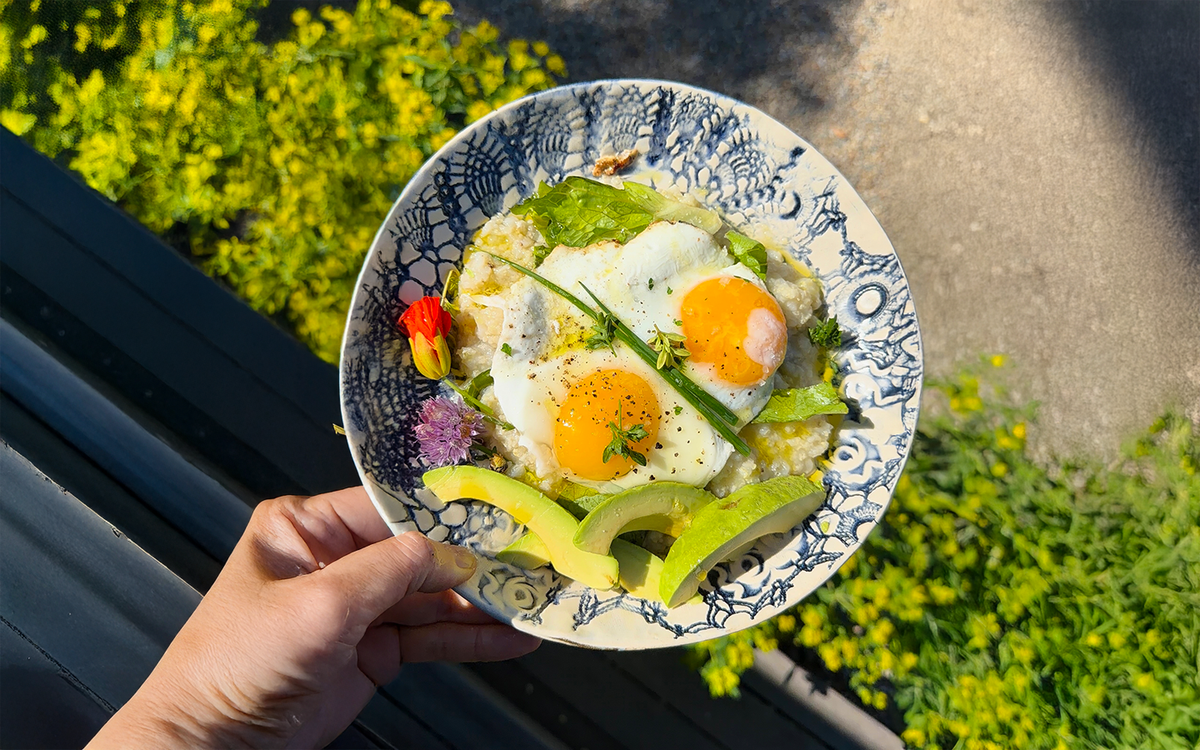
I am eating millet as the base of my morning meal — topped with slices of avocado, spinach from the garden, maybe some asparagus, two locally fried eggs, and a little sriracha, finished with extra virgin olive oil, Malden salt, and freshly cracked pepper.
Think: breakfast bowl.
It is served slightly warm or at room temperature, and not only does it keep me full for most of the day, it means I am getting foods that stabilize my blood sugar and keep me from grazing on whatever happens to be sitting on the counter. The protein from the eggs, the healthy fat from the avocado and olive oil, the fiber and complex carbohydrates from the millet — this is a breakfast that works.
An easy weekday move: whatever vegetables you ate the night before? Put them on top of the millet with the egg. A great use of leftovers.
If you are new to savory breakfasts, start smaller. Millet with a soft-boiled egg and a drizzle of olive oil is already a very good morning meal.
One more reason to love this grain
Millet is also high in fiber. Fiber seems to be having a moment — as everything does on the internet — but its importance is real. Adequate fiber intake supports cholesterol regulation, keeps the gut microbiome thriving, and plays a direct role in estrogen clearance, as we touched on above. The tiny, complex community living in your digestive tract (your microbiome) is quite literally fed by the fiber you eat. And a well-fed microbiome is one of the more underrated contributors to hormonal equilibrium in midlife. We go much deeper on this in our gut health and menopause post.
Millet is also naturally gluten-free, which makes it a welcome option for anyone dealing with gluten sensitivities alongside everything else midlife is asking of them.
Eat like a king in the morning
There is an old maxim: Eat breakfast like a king, lunch like a prince, and dinner like a pauper. The wisdom here is that front-loading your nourishment earlier in the day — giving your body a real, substantial breakfast and tapering from there — supports longevity, metabolic health, and yes, a trimmer waistline over time.
Millet fits this beautifully. It is slow and nourishing. Your body will figure out the rest.
If you are in perimenopause, working to support your hormonal balance, or simply looking for a breakfast that holds you without the drama — I hope you will give millet a chance. It has been a quiet shift in my own kitchen, and I genuinely did not expect to love it this much.
Wishing you many mornings that begin with something big, nourishing, and deeply satisfying. And if millet happens to become your new best friend — tell me about it.